

Do It Yourself Line Arrays
I started this website to document my journey to optimize audio replay in my home. In order to get great sound in my living room I’ve decided to build my own. I’ve ventured into DIY audio by building a pair of do it yourself line arrays. More specifically: build and design it yourself! After an initial period of trying to figure out which concepts could lead to some form of success, I’ve chosen to build myself a pair of full range floor to ceiling line arrays.
From Line Arrays to Mid/Side and Ambience
Over the past decade I have been exploring a question that many audio enthusiasts eventually ask themselves:
How realistic can stereo reproduction become in an ordinary living room if the loudspeaker, the room and the signal processing are treated as one system?
The document below is an attempt to put that journey into words.
It started with loudspeaker design and line arrays, then gradually expanded into room treatment, phase behaviour, Mid/Side processing and ambience support. Along the way I discovered that every improvement seemed to reveal another limitation, and that many of the things I had been hearing could be better understood through the work of researchers such as David Griesinger, Earl Geddes, Floyd Toole, Edgar Choueiri and others.
This paper is not presented as a recipe, nor as a claim of having found “the answer” to stereo reproduction. It is simply an honest account of one person’s attempt to make reproduced music behave a little more like a real acoustic event.
Some readers may recognise ideas they have experimented with themselves. Others may disagree with some of the choices. Both reactions are perfectly fine. If the paper encourages a few people to look at loudspeakers, rooms and stereo reproduction a little differently, then it has already achieved more than I expected.
Download: From Line Arrays to Mid/Side and Ambience – Version 1.1 (June 2026)
Line Arrays
Line arrays are a bit of a strange breed in Audio. They do act quite different compared to the more traditional multi-way speakers. Even though they do have some compromises of their own, they also have a couple of strong points. That alone could make them a valid choice for those that seek great sound in a small form factor.
They are not for the faint at heart though. Line arrays like the ones featured on this page need equalizing to be able to sound right. The use of EQ does not bode well in the HiFi scene. So if you’re against this kind of manipulation, line arrays are not for you. Otherwise: read on!
The Room
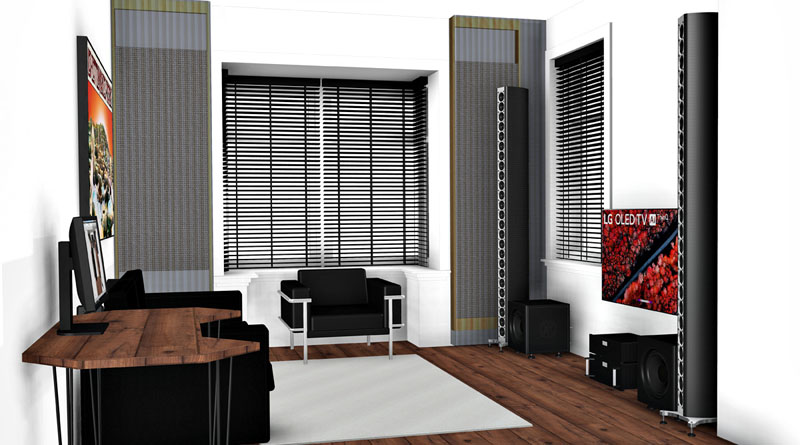
Whenever we bring a speaker into our home it won’t be as good as it was designed to be. Create the perfect speaker, bring it into your living room and all bets are off. However we can improve our room, to get overall better results. For some strange reason, once we start doing ‘improvements’ like that, we could quickly run into an argument with our spouses. I set out to find a solution that only needed minimal treatment of the room and still be able to perform above average.
Do It Yourself
So why the choice for do it yourself line arrays then? Well, for starters, line arrays occupy very little floor space while they do have several good things going for them in the way they interact within a room. They can be placed close to a wall, out of the way. They do need some adjustments to the room to be able to perform their best. Basically, the planes parallel to the line arrays need some attention. This way it is easy to absorb the most offending early reflections. The close to wall proximity has other advantages for bass performance.
With this Paypal button below you can make a donation if you like the content presented here.